
The Hidden Financial Drain of Security Guard Turnover and How to Stop It
High turnover is silently draining security firms’ profits. Learn the true financial cost—direct and indirect—and how to stop it with data-backed strategies from Belfry.

When a security officer leaves, it’s tempting to think the cost is just a couple hundred dollars for recruiting and a new uniform. Unfortunately, that’s just the tip of the iceberg. High turnover in the contract security industry is a profit drain, and for many firms, it’s happening at a scale that’s unsustainable.
In fact, industry churn averages 120% annually, meaning many companies replace their entire workforce every year. If your officers aren’t staying, you’re not just paying more to replace them…you’re also bleeding money through hidden channels you may not be tracking.
The Real Price Tag of Losing an Officer
Let’s start with what’s easy to measure, direct costs.
Every time an officer walks out the door, you incur:
- Job ads and recruitment fees. Posting on multiple job boards or paying agencies adds up quickly.
- Background checks. A necessary compliance step, but not free.
Uniforms and equipment. Often $150–$300 per hire, depending on gear. - Training and onboarding time. Paid hours spent learning, not earning.
Belfry’s Turnover to Tenure report calculates the average direct cost at $2,000 per departure. For a 300-officer firm, that’s $720,000 every year… and that’s before the indirect costs hit.

The Hidden Costs You Can’t See But Feel Every Day
The biggest financial damage from turnover is often hidden in operational inefficiencies.
- Un billed Overtime. When shifts go uncovered, supervisors or senior guards step in, often at overtime rates. In many cases, these hours aren’t billable to the client, meaning you absorb the cost.
- Compliance Risk. When you’re constantly onboarding, you increase the chance of missed training, expired licenses, or incomplete background checks; all of which can expose you to legal or contractual penalties.
- Lost Revenue Opportunities. If your managers are constantly firefighting to fill posts, they’re not out selling new contracts or upselling existing clients. This is a quiet but powerful way turnover strangles growth.
“Replacing one officer costs $2,000. Multiply that by a 120% turnover rate, and the losses are staggering.”
— Belfry’s Turnover to Tenure’ Report
The Ripple Effect of Churn on Your Team
High turnover doesn’t just cost money; it costs morale. Officers who stay often have to cover for those who leave,l eading to burnout and disengagement. That disengagement feeds back into turnover, creating a costly cycle.
This is why Belfry’s data shows that reducing turnover even slightly can have outsized financial and cultural benefits.Lower churn means:
- More experienced officers on post
- Better client satisfaction scores
- More predictable scheduling
- Less stress on supervisors
Why Most Security Firms Underestimate Turnover Costs
Many security firm owners think of turnover as an unavoidable line item. But there are two key reasons costs are often underestimated
- Failure to measure indirect costs. Supervisors’ time, overtime coverage, and lost opportunities aren’t always tracked in financial reports.
- Not connecting turnover to downstream issues. High churn impacts service quality, compliance, and even insurance costs over time.
By quantifying both direct and indirect costs, you gain a clearer picture of how urgent it is to take action.
Hypothetical Example: The 10% Fix
Imagine a mid-sized Southeast security firm with 300 officers and an annual turnover rate of 125%. Using Belfry’s benchmarks, they estimate their direct turnover cost at around $850,000 per year.
By applying three core strategies: competitive pay benchmarking, predictable schedules using Belfry’s Shift Marketplace, and mobile onboarding that cut new hire paperwork from 2 hours to25 minutes, they could plausibly reduce turnover to 95%.
That drop would save over $200,000 annually in direct and indirect costs, freeing up budget for further pay increases and technology investments.
This scenario is based on averages fromBelfry’s Turnover to Tenure report and is intended to illustrate the potential ROI of targeted retention strategies.
Three Steps to Stop the Bleed
1. Benchmark and Adjust Pay
If you’re in the bottom quartile for your market, you’re fighting an uphill battle. Belfry’s report includes state-by-state medians so you can set competitive wages.

2. Build Scheduling Stability
High call-off rates correlate with higher turnover (r = 0.68). Predictable schedules, combined with mobile self-service, cut no-shows and reduce overtime.

3. Focus on the First 90 Days
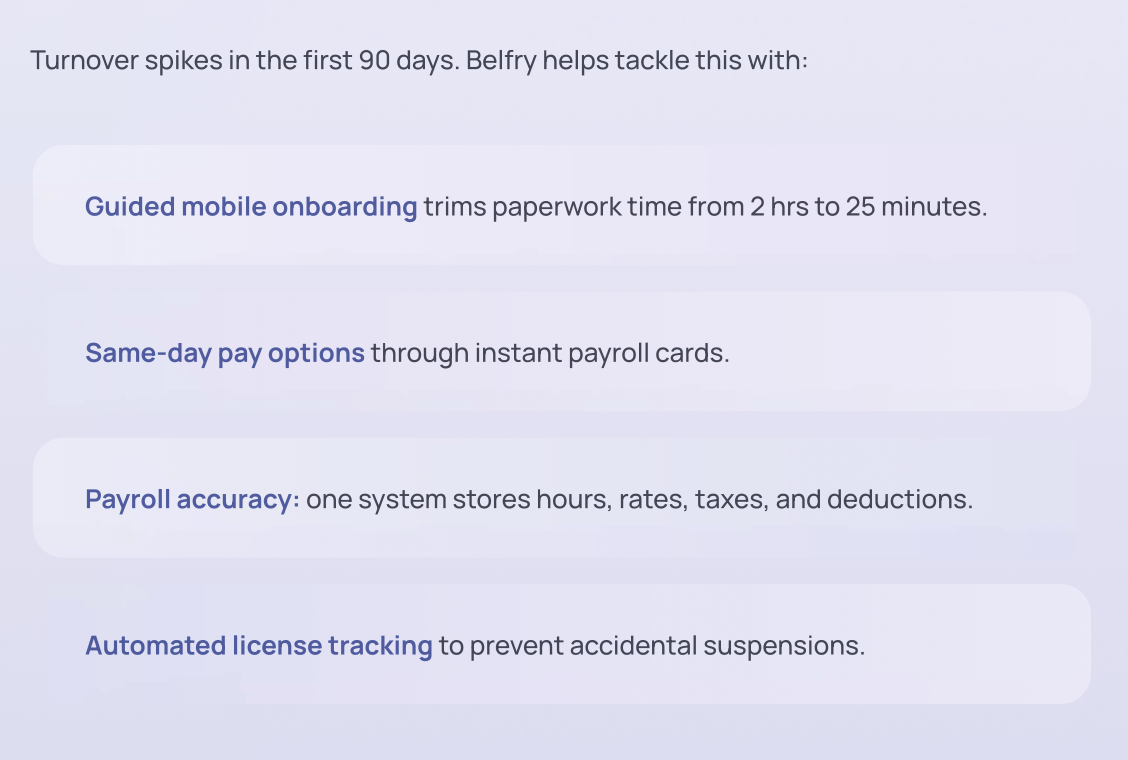
Turnover spikes in the first month. Streamline onboarding, ensure payroll accuracy, and track early engagement closely.
How to Quantify Your Own Cost of Turnover
Belfry’s Turnover Cost Calculator walks you through:
- Number of annual separations
- Direct replacement costs
- Estimated indirect cost multipliers
- ROI of retention strategies
When you put real numbers to your churn, it’s much easier to justify investments in pay, scheduling, and onboarding improvements.
Quick Fact:
A 300-officer firm with industry-average turnover (120%) is likely losing $720,000+annually in direct costs alone.
Your Next Step
Turnover is not an unavoidable cost of doing business—it’s a solvable problem with measurable ROI.
Download the full Turnover to Tenure report to get the formulas, benchmarks, and step-by-step strategies to cut churn in half.
Explore Belfry Shift Marketplace to fill posts faster and eliminate costly un billed overtime.

