
California meal and rest break premiums without the timecard hunt
How California security companies can pay meal and rest break premiums correctly without checking every timecard by hand.

For California security companies, a missed break is more than a note on a timecard. It can mean an hour of premium pay, and if that premium goes unpaid, PAGA penalties of up to $100 per employee, per pay period.
Whether you owe the premium depends on why the break was missed. If the officer had a real chance to take it and chose not to, you generally don’t. If they couldn’t take it, you do.
Most firms still sort that out by hand, one shift at a time. Here’s what that really costs, the rules behind it, and a simpler way to handle it.
The real cost of checking every timecard
If you run payroll for a California security company, you probably know payroll week well. Someone opens every timecard, across every site, and checks each break. Was it taken? Was it long enough? Did it start on time? If not, why?
With 100 officers working five shifts a week, that’s 500 timecards a week, or 1,000 every two-week pay period. Most of them are fine. Your team still has to open every one to find the few that aren’t.
The ones that aren’t take the most time:
- Chasing officers. A break shows as missed, so someone calls or texts the officer to ask what happened. Days later, they don’t remember.
- Working out premiums. Each premium gets calculated at the officer’s regular rate, often in a spreadsheet, then keyed into payroll one employee at a time.
- Running out of time. Payroll has a deadline. When the checks aren’t done, it runs anyway.
And after all that work, payroll can still go out wrong. A premium gets missed, or one gets paid for a break the officer actually took but forgot to log. Some firms give up and pay a premium on every shift just to be safe.
The rules your team checks on every shift
California’s break rules are simple to state and hard to check at scale.
| Break | When it's owed | If it's missed |
|---|---|---|
| Meal | 30 minutes after 5 hours of work, and a second after 10 | 1 hour of pay at the officer's regular rate |
| Rest | 10 minutes for every 4 hours of work | 1 hour of pay at the officer's regular rate |
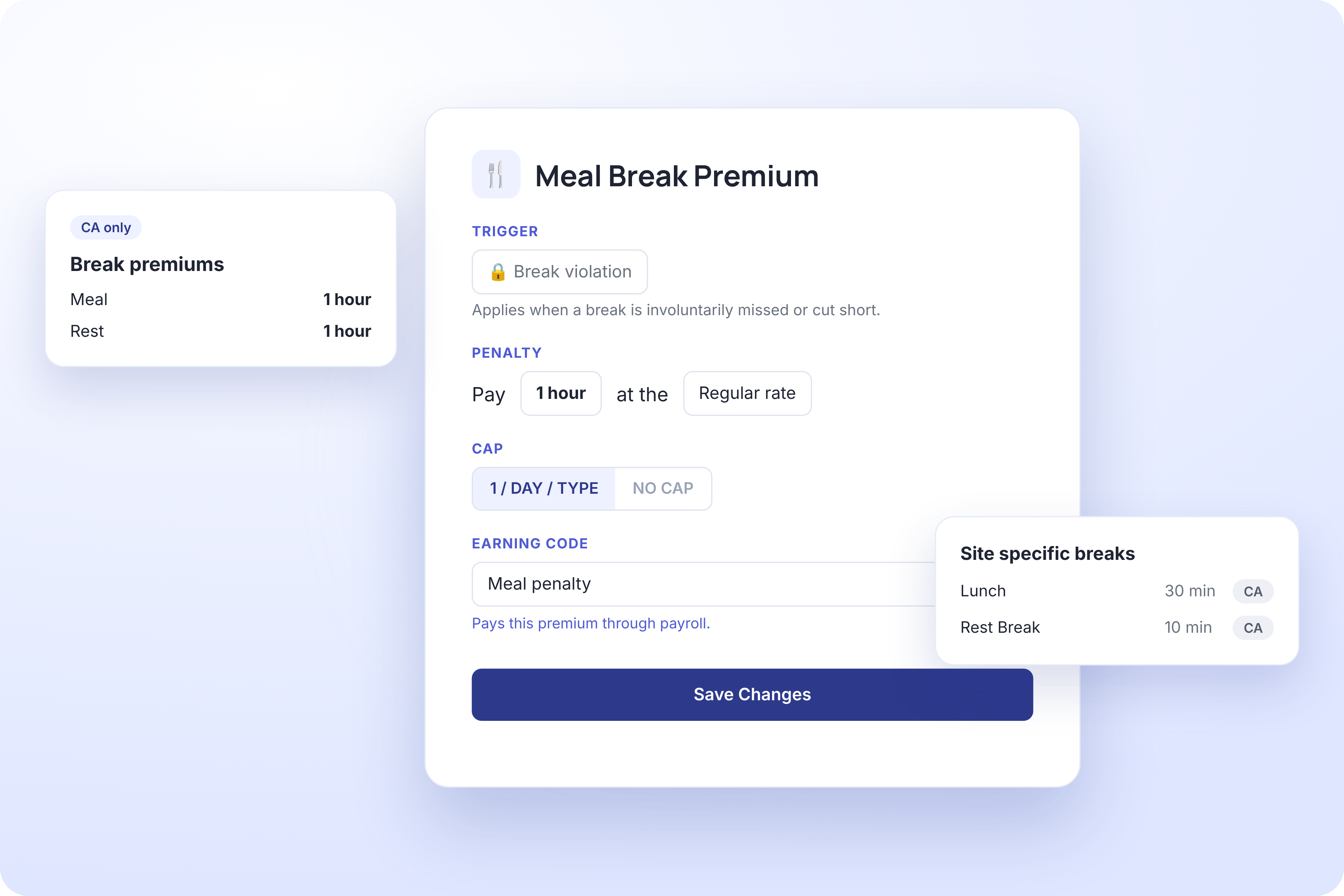
An officer can earn at most one meal premium and one rest premium per workday. Miss two rest breaks in a day and they’re owed one rest premium, not two. Miss a rest break and a meal break and they’re owed one of each.
The hard part is the detail. A meal break that ends a few minutes early can count as short. One that starts too late can count as late. Your team has to catch both, on every timecard.
Why doing it by hand breaks down
The rules aren’t the problem. The process is. Most firms track breaks in one place, collect attestations in another, and work out premiums in a spreadsheet. Each handoff is a chance for something to slip.
- Officers forget to log breaks. Many “missed” breaks were actually taken. Without the real times, you either pay a premium you didn’t owe or spend payroll week tracking the officer down.
- The reason gets lost. A timecard shows a break ended early. It doesn’t show why. By the time someone asks, the officer has worked five more shifts.
- Everything gets checked, not just the problems. Your team reviews hundreds of clean timecards to find the handful that need a decision.
- Premiums are entered one at a time. Every premium is a manual entry, and every manual entry can be wrong.
Want to see what this looks like without the spreadsheet? See how Belfry handles break compliance.
Why the officer’s reason matters
Not every missed break means you owe a premium. If the officer was given the chance to take a break and chose to skip it, that’s voluntary. If a post couldn’t be covered, or a supervisor kept them working, that’s involuntary, and a premium is owed. One catch for security companies is that a rest break only counts if the officer is fully off duty. If they stay on call, with a radio on and ready to respond, a premium is still owed.
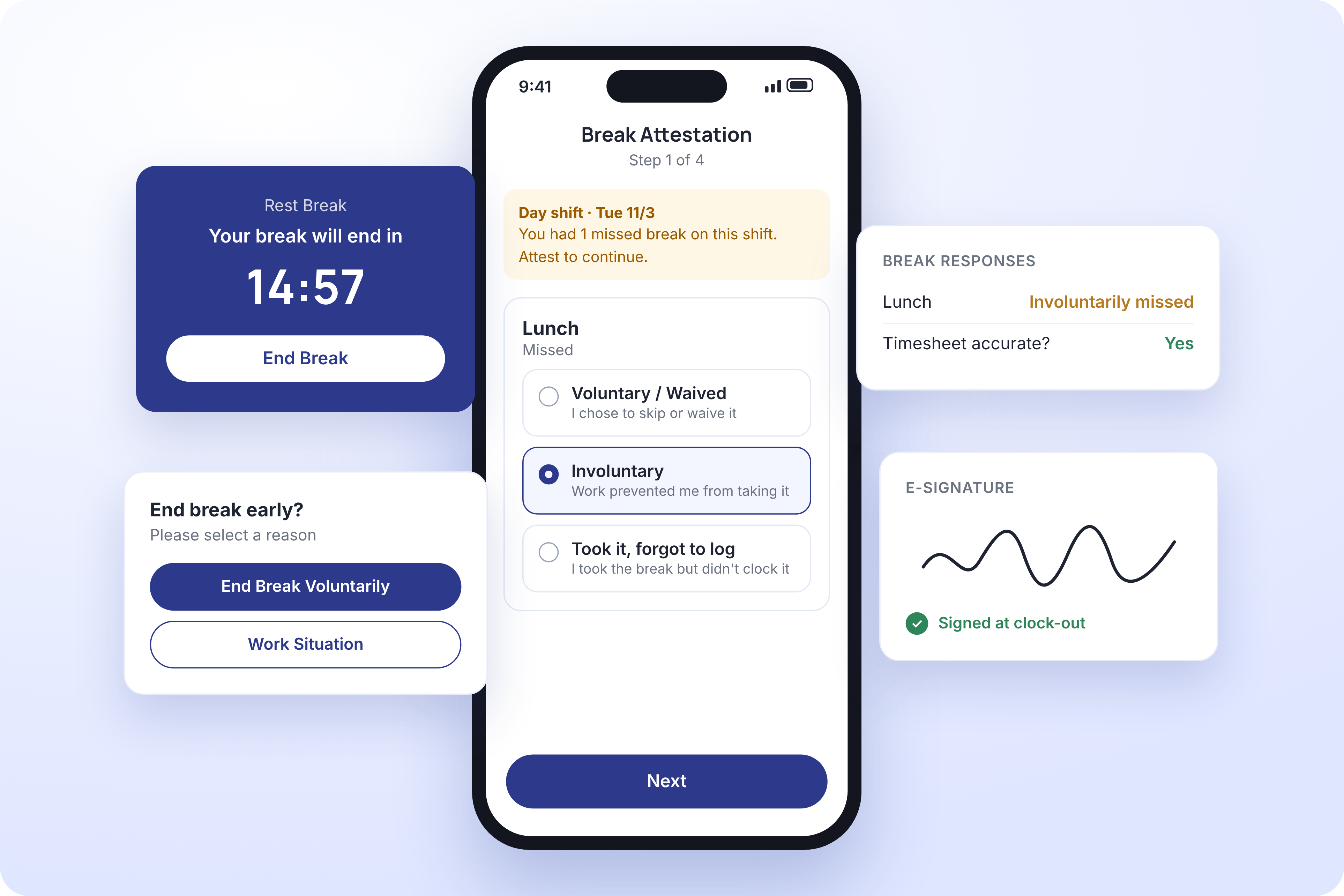
That makes the officer’s answer the deciding fact. And the best time to get it is at clock-out, while the shift is fresh. Ask three days later and you’ll get a guess. Ask at clock-out and you’ll get a signed answer.
A good record for each missed break includes:
- Whether it was voluntary or involuntary
- The officer’s reason in their own words
- Their signature and the time they signed
What a solid break record looks like
If an employee or their attorney asks about breaks, you’ll want to show what happened on each shift, not reconstruct it from memory. For every break, that means:
- The shift, with scheduled and actual break times
- The officer’s attestation and signature
- Any changes your team made, and whether the officer agreed
- Internal notes from whoever reviewed it
- The premium paid, if one was owed
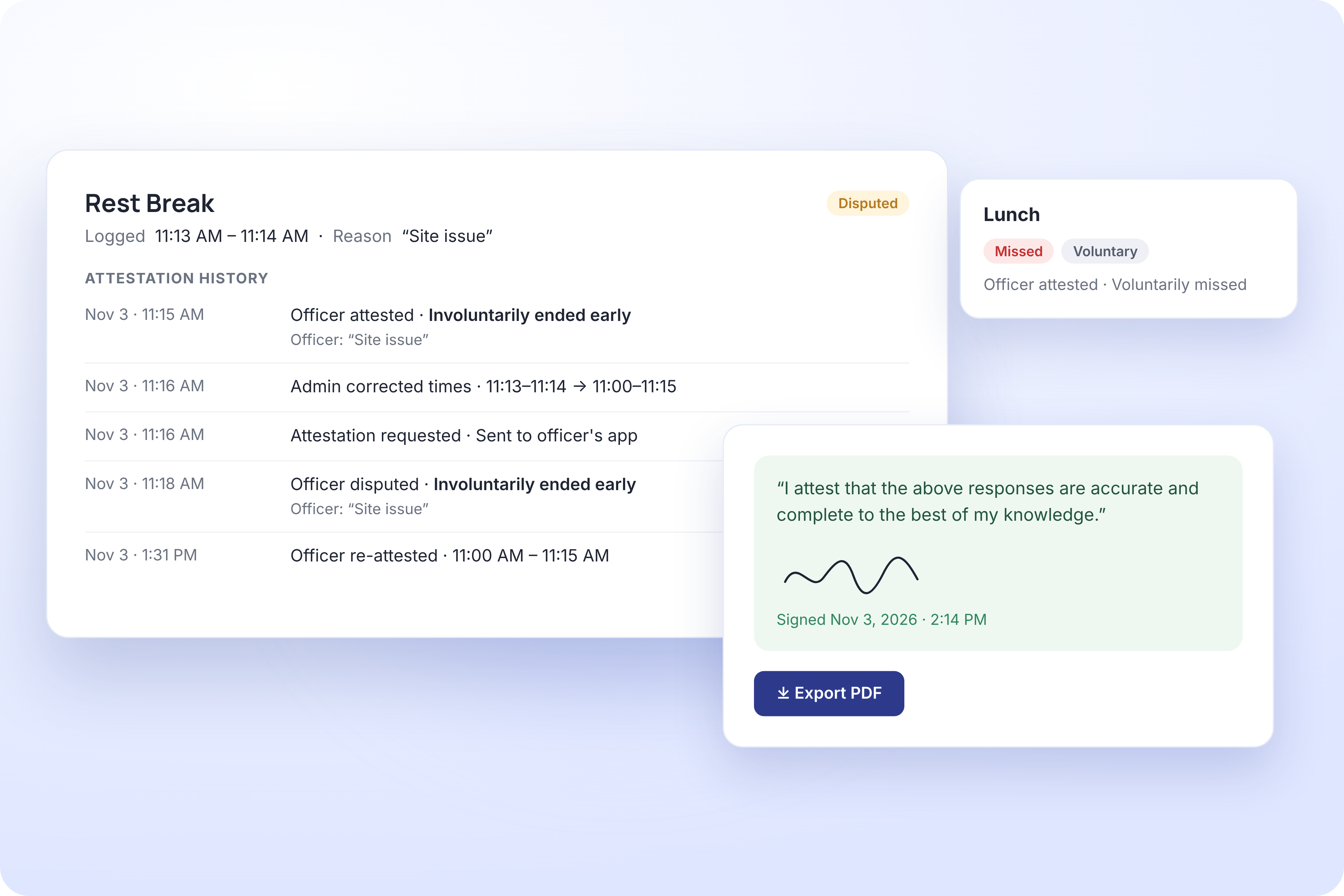
Keeping that in one place, for every officer, is close to impossible with spreadsheets and paper. It’s easy when it’s built into your timekeeping.
How Belfry handles it
Belfry builds break compliance into scheduling, timekeeping and payroll, so your team spends less time checking timecards.
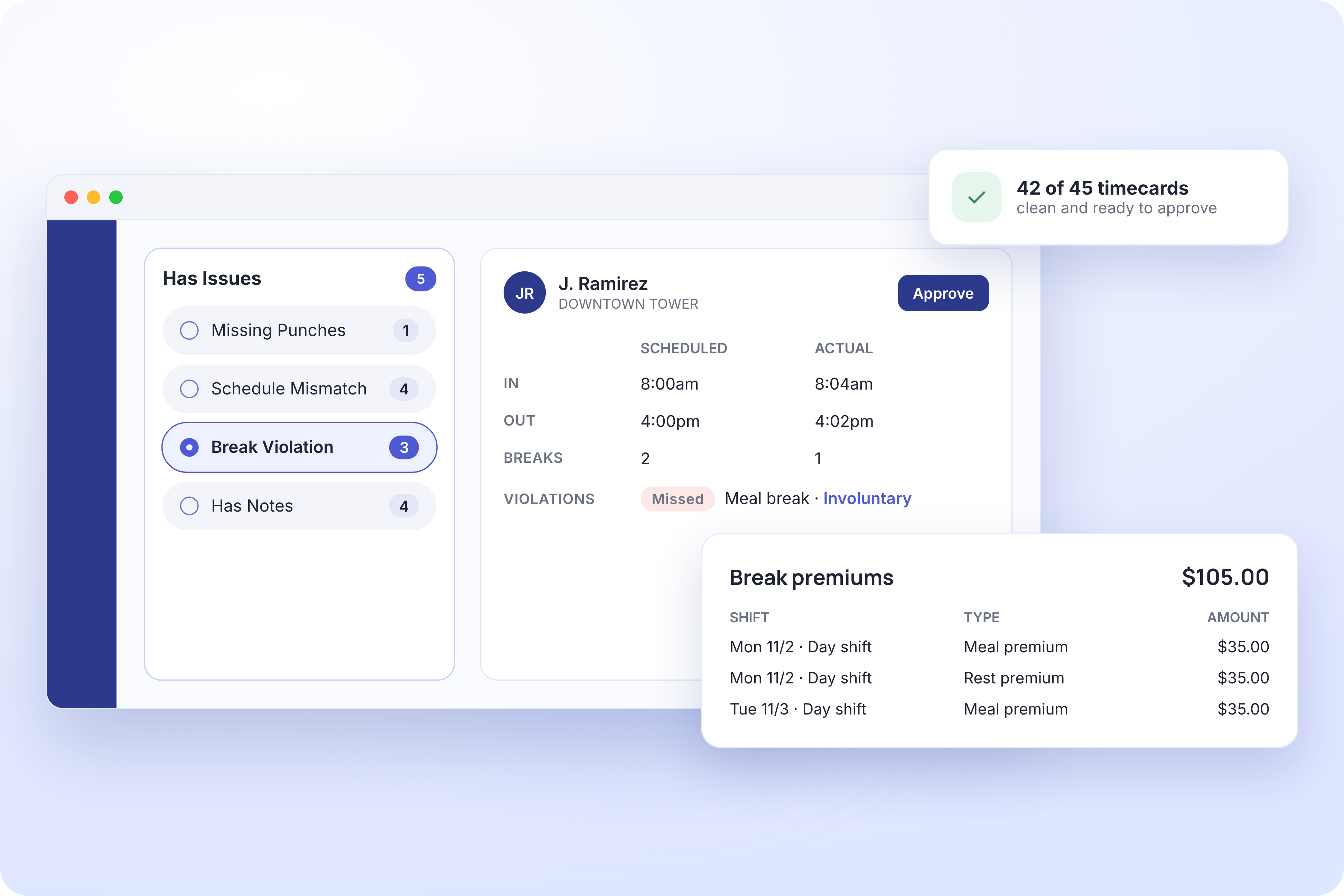
- Belfry flags the problem. Missed and short breaks are flagged automatically, based on the break rules you set for each site. You can flag late breaks too.
- The officer explains it at clock-out. They choose voluntary or involuntary, give a reason and sign. If they took the break but forgot to log it, they enter the real times and their timecard updates.
- Your team sees the exceptions first. Timecards with break violations are flagged for easy review.
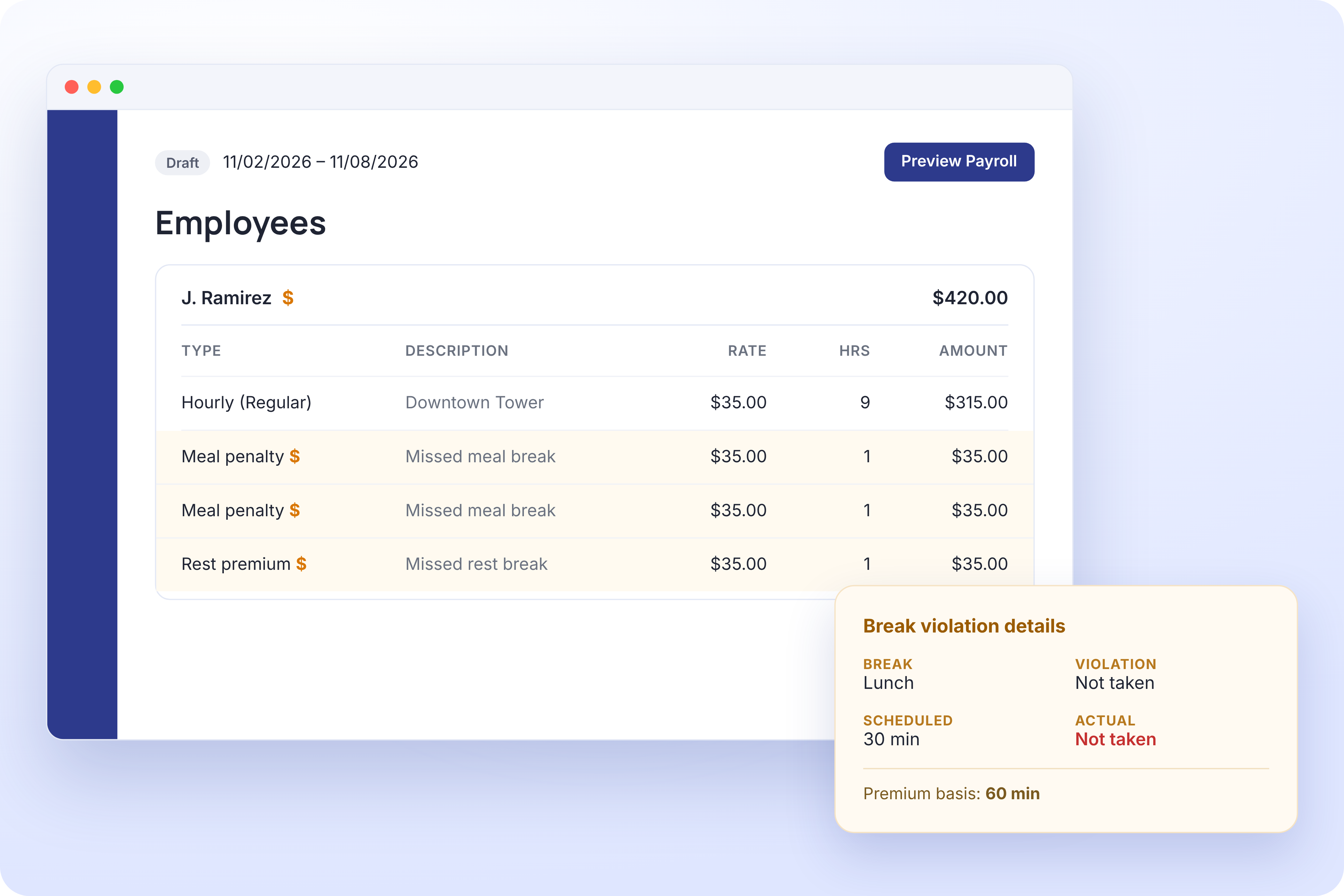
- Premiums land in payroll. Belfry calculates each premium at the officer’s regular rate and adds it to your payroll draft, so you can check it before you run payroll.
Every attestation is saved on the officer’s profile, with the full history of changes. You can filter and export them any time.
Not in California? Officer attestations work in every state. Every missed or short break gets the officer’s reason and signature, so you have a record wherever you operate.
The result: less time checking timecards, premiums paid correctly, and a record for every break.
Not legal advice. Consult your employment counsel about your specific obligations.

